Health Insurance
Should You Use a PEO? An Honest Look

Nikhil Naggarwal
PEOs promise to simplify HR for small businesses — but at $100–200 per employee per month, they're not right for everyone. Here's an honest look at when a PEO makes sense, when it doesn't, and how to compare it against ICHRA and group health before you sign anything.

If you just got off the phone with a PEO rep, you probably heard a version of the same pitch: better benefits, less HR headache, large-group rates you can't get on your own. Sometimes that's true. Sometimes it's a $36,000 annual admin fee that nobody calculated before signing. This guide walks through the honest version of the PEO story: when the math works, when it doesn't, what it actually costs, and what nobody tells you about getting out. We have no financial stake in which direction you go. That's the point.
What a PEO Actually Is (and What Co-Employment Means)
PEO stands for Professional Employer Organization. The name makes it sound like someone is taking over your company. That's not what happens.
What a PEO does is become a co-employer of your staff alongside you. Your employees are technically employed by both you and the PEO at the same time. This is a real legal arrangement, not just an administrative convenience.
The reason businesses do this: the PEO pools your team with its entire client base. We're talking tens of thousands of employees across hundreds of small businesses. That pool lets the PEO purchase health insurance at large-group rates. Large-group rates are generally better than what a 12-person firm can access on the small-group market. That rate differential is the core of the PEO pitch.
The PEO also handles the administrative infrastructure: payroll processing, benefits administration, workers' comp coverage, HR compliance support. You keep control of the actual business. Who you hire, what your team works on, how you run things, that stays with you. The PEO handles the paperwork side.
The major players each have a different focus. TriNet is built for tech startups and has deep California penetration. It works well for knowledge-worker companies with a competitive hiring bar. Justworks is positioned as clean and simple, popular with mid-market companies that want benefits administration without a lot of complexity. ADP TotalSource brings large-company compliance infrastructure to a small-business division and has broad national reach. Insperity tends to serve more established SMBs, particularly in professional services, where the HR advisory component has real value.
Each has a genuine sweet spot. Whether your business fits one of them is a different question.
What a PEO Actually Costs
Most PEO conversations lead with the large-group rates story. The admin fee tends to come up later, in smaller type.
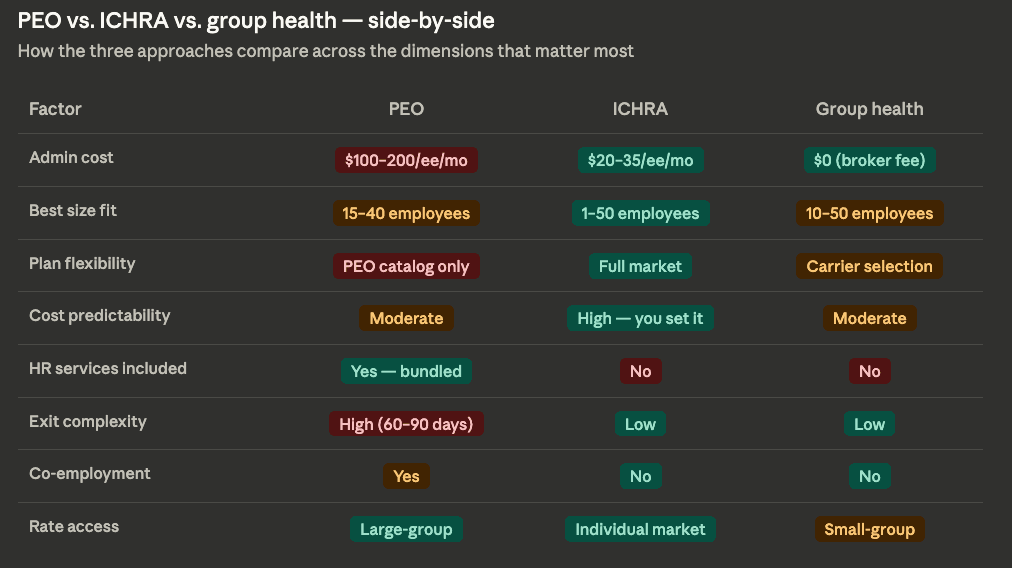
PEOs charge an administrative fee of approximately $100 to $300 per employee per month. This is on top of whatever the health insurance premium costs. It covers payroll processing, HR administration, compliance support, and the operational overhead of the co-employment model. It is not the benefits premium. It is in addition to the benefits premium.
Here is what that looks like in annual terms:
5 employees at $150/month admin fee: $9,000/year in admin fees alone
10 employees at $150/month admin fee: $18,000/year in admin fees alone
20 employees at $150/month admin fee: $36,000/year in admin fees alone
30 employees at $150/month admin fee: $54,000/year in admin fees alone
That $18,000 for a 10-person firm is roughly what many small businesses spend on a part-time hire. It is real money that needs to be justified by real savings on the other side of the ledger.
This doesn't make PEOs bad. It means the question is whether the savings on benefits rates, plus the value of outsourcing HR administration, add up to more than the admin fee. For some businesses, yes. For others, no. Most businesses don't run that comparison before signing.
When the PEO Math Works
There is a genuine use case for PEOs. Here is what it actually looks like.
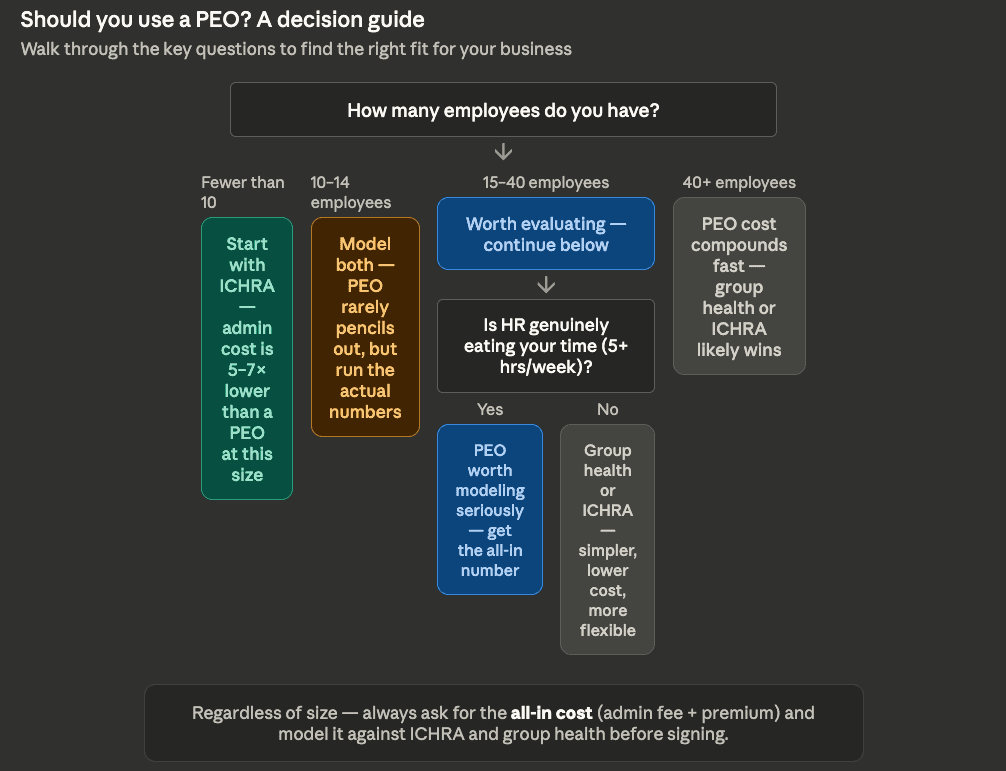
You have 15 to 40 employees. This is the range where PEOs most consistently pencil out. Under 15, the admin fee is usually too high relative to the value delivered. Over 50, you may have enough scale to access competitive benefits directly without paying a per-employee administrative fee on top.
HR is genuinely eating your time. If you or your ops person is spending 5+ hours a week on payroll questions, workers' comp certificates, open enrollment logistics, and compliance questions, that time has a real cost. A PEO bundles all of that into one vendor relationship. When an HR hire is the alternative, the PEO often beats that comparison.
Benefits quality matters for recruiting. A PEO's large-group access can give a 20-person company a benefits package that competes with what a 200-person company offers. Richer dental, vision, 401k, and FSA options. That matters in markets where you're recruiting against companies ten times your size.
You're in a state where small-group rates are high. In California and other expensive markets, the gap between small-group community-rated premiums and large-group experience-rated premiums can be significant. The rate arbitrage is more meaningful there.
Here is what the math actually looks like for a 20-person firm. The PEO admin fee at $150/month is $36,000 per year. If large-group rates save $80 per employee per month versus your current small-group rates, that's $19,200 per year in premium savings. The gap is $16,800. For the PEO to make financial sense, the HR services you're getting need to be worth at least that much to your operation. For some businesses, they clearly are. For others, they are not.
When a PEO Doesn't Make Sense
This section gets left out of most PEO evaluations. It shouldn't.
You have fewer than 10 employees. ICHRA or small group is almost always the better choice for health insurance at this size. ICHRA (Individual Coverage Health Reimbursement Arrangement) lets you set a monthly reimbursement amount, each employee buys their own plan on the individual market, and you reimburse them tax-free. Platforms like Thatch and Take Command run $20 to $45 per employee per month to administer. That is about 15% the admin cost of a PEO. Employees also get their own plans with their own carriers and their own networks, not whatever plan your group landed on.
Your benefits needs are straightforward. If you want health insurance and a dental/vision plan, a PEO is over-engineered. A standard small-group plan with a good broker covers that at lower total cost with more flexibility. You do not need co-employment and bundled payroll to offer health insurance.
You care about plan design flexibility. PEOs offer their catalog. If your PEO doesn't carry Kaiser Permanente and half your team specifically wants Kaiser, that's a problem you can't solve from inside the PEO. A direct group plan or ICHRA lets you shop the full market.
You're growing fast toward 50+ employees. The PEO admin fee compounds with every hire. As you scale past 40-50 employees, the product may no longer fit your needs and the cost structure becomes harder to justify. You may find yourself doing a disruptive mid-growth exit at exactly the wrong moment.
Co-employment has real implications. Some owners prefer to retain full HR control over hiring, terminations, and HR decisions. Co-employment means the PEO is a legal party in those relationships. That's worth understanding before you're in it.
The Exit Problem — What Nobody Tells You
This is the section most PEO sales conversations skip. It's the one you should read most carefully.
Leaving a PEO is significantly harder than joining one. Not impossible. Not catastrophic. But harder, and you should know what it looks like before you sign.
Benefits coverage ends when you leave. Your employees' health insurance is tied to the PEO's group plan. When you exit the PEO, that coverage ends. Every employee transitions to whatever you set up independently. There is no continuity of coverage from the PEO plan to the new plan.
You rebuild HR infrastructure at the worst possible moment. At the moment of exit, you need new vendors simultaneously: a new payroll processor, new workers' comp coverage, new benefits administration, and whatever compliance support you were getting through the PEO. All of that on top of managing the benefits transition for your employees.
Established doctor relationships may not survive. Employees who have built care relationships with specific doctors or specialists through the PEO's carrier network may not have those providers covered under your new independent plan. This is a real quality-of-life issue for employees, and it almost never comes up in the initial PEO evaluation.
The transition takes 60 to 90 days. Exiting requires careful timing so employees don't experience coverage gaps between the PEO plan ending and the new coverage starting. Manageable with proper planning. But it requires planning.
Here is the honest framing: a PEO is not a month-to-month decision. It is a 2-to-3 year commitment in practice. If the math works and you're confident in the relationship, that's fine. If you're uncertain about whether you'll still want this product in year 2, that uncertainty belongs in your evaluation now.
The Two Questions to Ask Before Signing Up
Before you commit to any PEO, ask two three questions. The answers will tell you a lot.
"Show me the all-in cost breakdown: admin fee plus estimated benefits premium per employee per month."
You want one number: total monthly cost per employee for everything. Admin fee plus premium. Not separately. Not estimated. Not "it depends on your final census." If a PEO rep won't give you a clear all-in number before you sign, that is a red flag. The number exists. They just may not want to show it to you that way.
"What does exiting look like if I decide this is not the right fit in year 2?"
Ask for the specific process and timeline. How many days does transition take? What do you need to set up? What happens to employee records? What is the benefits gap risk? A good PEO will answer this clearly. A rep who deflects or says "let's cross that bridge when we come to it" is telling you something important.
The Honest Bottom Line
Most of the time, the answer to "should I use a PEO" is sitting in a comparison nobody ran before the sales call ended.
If you have fewer than 10 employees, start with ICHRA. The cost difference is large and the product is a better fit for your size.
If you have 15 to 40 employees, HR is genuinely costing you time, and you want a benefits package that helps you recruit, a PEO is worth modeling seriously. Run the actual math. Get the all-in number. Compare it to direct alternatives.
If you're somewhere in between, or if you have specific flexibility needs, or if you're growing fast and the cost structure concerns you, there are usually better answers than a PEO for your situation.
Here is where Corridor fits in. We are a health insurance broker. We are paid by the carrier when you buy a group plan or ICHRA through us. We are not paid by PEOs and we earn nothing if you go that route.
So when we tell you a PEO might be right for your situation, that's a genuine assessment. We have no financial reason to say it otherwise.
If a PEO is the right answer, we will tell you that and make introductions to the right provider for your size and state. If group health or ICHRA makes more financial sense, we will show you the actual numbers and let you decide. We work with small businesses in California, Georgia, and Ohio. Getting a comparison costs nothing.
Written by Nikhil Aggarwal CEO & Co-Founder, Corridor Advisors
Licensed Health Insurance Broker | NPN: 22108801
Corridor Advisors is a health insurance brokerage for small businesses with 1-50 employees.
Related Articles




Small businesses are the backbone of America.
20 million Americans get their health benefits from a small employer. Corridor is the brokerage built to serve them.