Health Insurance
What Does a Health Insurance Broker Actually Do?

Corridor Editorial
Most small businesses have a broker — they just don’t know what they actually do. Brokers are paid by carriers, not you, but the real difference is whether they actively shop the market and re-evaluate your options each year, or just let you auto-renew and overpay.
No items

Most small business owners I talk to have a broker. They just have no idea what that broker actually does — or how they get paid. Someone told you to get one. Maybe it was your accountant, maybe a friend. You signed some paperwork, employees got enrolled, a renewal letter shows up every year, and you mostly just go with it.
That is how this industry works for most people. This guide is about changing that. It explains what a broker is actually supposed to do, what separates a good one from a mediocre one, and how to know which kind you have. The answers are simpler than you think.
The Thing Most People Don't Know: Brokers Are Free
Here is the thing almost nobody tells you upfront: you do not pay your broker.
When you enroll your business in a health plan, the insurance carrier pays your broker a commission. It is built into the premium you already pay and you never receive a separate invoice or write a check to your broker. They get paid in the background every month, for as long as you stay on that plan.
This sounds too good to be true, so let me explain why it is actually true.
Carriers want distribution. They need businesses like yours to choose their plans. Brokers are the channel that makes that happen, so carriers fund them. The employer gets professional help at no direct cost. The carrier gets access to your business, and everyone has a reason to participate.
There is plenty of nuance, though. For example, in California, commission rates for small group plans are standardized by the carrier. That means your broker earns roughly the same amount regardless of which carrier you choose or which plan tier you land on. A more expensive plan does not pay your broker more. This is great for you, as it removes the biggest potential conflict of interest in the relationship.
Captive vs. Independent: The Most Important Distinction
There are two fundamentally different kinds of brokers, and most small business owners have no idea this distinction exists.
A captive broker works for one carrier, or a small set of carriers. That is the only thing they can quote. Think of it like a car dealership: a Ford dealer can only sell you Fords. They cannot tell you whether a Toyota would be a better fit for you, because they have never looked at a Toyota.
An independent broker works across the whole market. They are not tied to any carrier. They can pull quotes from every major insurer in your area and give you real comparisons.
Here is the concrete consequence of that difference.
In California's small group market, the monthly cost per employee for similar coverage can vary by $80 to $150 depending on which carrier you choose. That is not a small difference. For a 10-person company, that is $800 to $1,500 per month — $9,600 to $18,000 per year. A captive broker cannot show you that spread because they only have access to one carrier's pricing.
Broker type | Carriers quoted | Who they actually work for |
|---|---|---|
Captive broker | 1 | The carrier |
Limited independent | 2 to 3 | Nominally you, but narrowly |
Independent | 5 to 7 or more | You, if they are doing it right |
The single most useful question you can ask any broker is: "How many options will you quote?"
If the answer is one or two, you are either talking to a captive broker or an independent who is not doing their job. A good independent broker should be quoting four to six or more carriers. That is what "shopping the market" actually means.
What Your Broker Is Actually Doing for You
Here is what a broker engagement actually looks like when someone is doing the job well.
It starts with your census. Your broker will ask you for a list of the employees you plan to cover, with their dates of birth and zip codes. That is enough to pull real quotes from every carrier, not ballpark estimates.
Then they run the full market. Every major carrier in your rating area. Every plan tier. They should be modeling both traditional group health and ICHRA (more on that below) so you are seeing the actual range of options, not just the familiar one.
Then they present options with real tradeoffs. Not a stack of PDFs. A clear explanation: here is what you pay, here is what your employees pay, here is what the out-of-pocket exposure looks like, and here is why one option might fit your group better than another.
Then they handle enrollment. Paperwork, carrier portals, employee communication, effective dates. The best brokers just handle it. You should not be spending your Friday afternoons on this.
Then they manage the ongoing relationship. Employee questions about claims, mid-year additions, terminations, life events. A good broker answers the phone when employees call, not just when you do.
And then comes renewal. This is the moment that separates good brokers from mediocre ones, and it is where most of the money gets lost.
The Difference Between a Good Broker and a Mediocre One
You should be able to read this list and immediately know which kind you have.
A mediocre broker:
Shows you 1 to 2 plans and calls it shopping
Forwards the renewal letter and asks if you want to stay on the same plan
Takes days to return calls or emails
Has never mentioned alternatives (ICHRA, Level-Funded, PEO)
Handles enrollment once a year and goes quiet
Can't clearly explain how they get paid
A good broker:
Quotes 4 to 6 carriers and models multiple plan configurations
Re-shops every renewal without being asked, and brings you a comparison
Responds quickly to employee questions directly, not just to the owner
Explains their commission clearly if you ask, without getting defensive
The gap between these two is not effort, it is structure. Some brokers have a process built around doing the minimum to keep your account. A good broker has a process built around proving they're worth keeping.
The Renewal Problem — And What Good Looks Like
Every year around renewal time, most small businesses get a letter from their carrier. Rates are going up. The broker forwards the letter. You accept it. Repeat next year.
This is the auto-renew trap, and it is how small businesses quietly overpay by tens of thousands of dollars over time.
The problem is not just the single increase. It is the compounding.
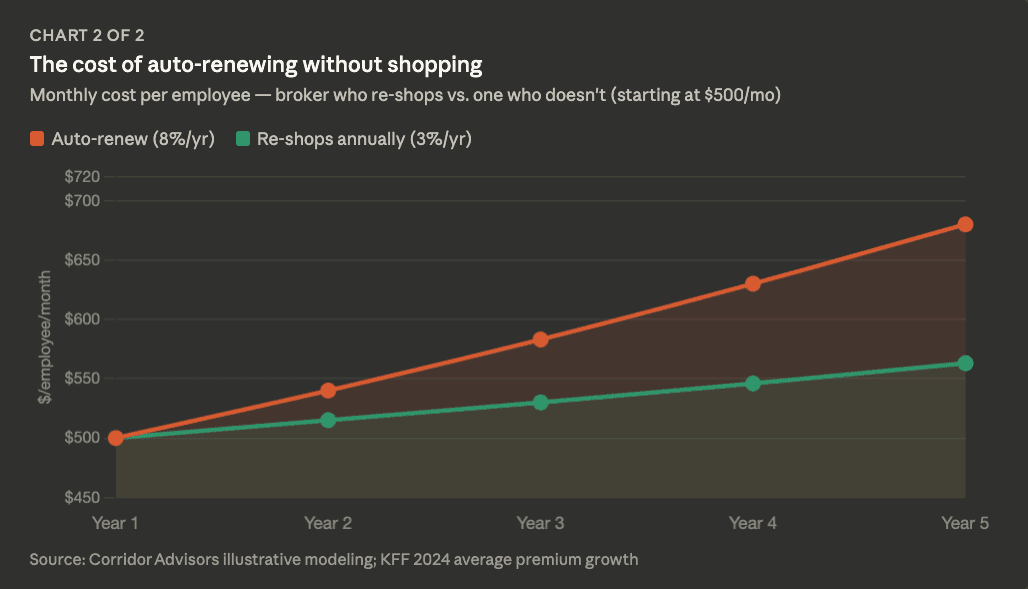
Say you are paying $500 per employee per month today. Your carrier raises rates 8% per year and your broker never re-shops:
Year 1: $500
Year 2: $540
Year 3: $583
Year 4: $630
Year 5: $680
Now say you had a broker who actually went to market at every renewal. Competition keeps your effective annual increase to around 3%:
Year 1: $500
Year 2: $515
Year 3: $530
Year 4: $546
Year 5: $563
The Year 5 difference is $117 per employee per month. That is $1,404 per employee per year. For a 10-person firm, that is more than $14,000 in unnecessary spend in a single year. And the overpayment started building in Year 2.
That is not a rounding error. That is a meaningful chunk of payroll.
What does re-marketing actually look like? Your broker takes your current employee census to every carrier in the market and asks for their best rate. It takes them a few hours. Carriers compete aggressively for new business, so your renewal number is almost always beatable. A good broker does this every year and brings you a comparison before your renewal date. You decide whether to stay or switch. They handle the transition either way.
If you have never received that conversation, you have been auto-renewing.
Three Questions That Separate Good Brokers from the Rest
You can learn almost everything you need to know about a broker by asking three questions.
"How many options will you quote?"
This one question tells you whether you are talking to a captive or a real independent, and it tells you how seriously they take their job. The right answer is: every major carrier in your market, usually four to six or more. A broker who quotes one or two is not showing you the full picture, either because they can't or because they won't.
"Will you model both group health and ICHRA for my situation?"
ICHRA stands for Individual Coverage Health Reimbursement Arrangement. Instead of buying a group plan, you give each employee a fixed monthly budget of tax-free money to buy their own individual plan. For employers with fewer than 10 employees, distributed teams, or workforces with very different needs, it is often the better answer. Platforms like Thatch, Take Command, and Salusion administer it for roughly $15 to $45 per employee per month.
If a broker has never heard of ICHRA, or brushes it off without modeling it, they are not giving you a complete analysis. That is useful information.
"Will you re-shop at every renewal without me asking?"
The word to listen for is "automatically." A broker who says "we will re-shop if you ask" is telling you they are not going to do it unless you push them. The right answer is: we come to you before every renewal with a full market comparison, whether rates went up or not. You decide. We handle the rest.
Ask these three questions. The answers will tell you what you are working with.
The Bottom Line
A good broker costs you nothing and saves you real money. A mediocre one also costs you nothing, but the auto-renewing and the narrow quoting and the silence at renewal time adds up in ways that are easy to miss until you run the math.
The most important structural question is: are they independent, and are they actually doing the work? Independent means they can quote every carrier. Doing the work means they re-shop without prompting, they model ICHRA when it makes sense, and they answer your employees' questions without you having to relay them.
If you want to see how this works in practice: Corridor is an independent brokerage. We quote every carrier in your market, run the ICHRA comparison for any group under 10, and re-shop at every renewal without you having to ask. If we are not the right fit for your situation — lack of expertise , too many employees, something genuinely outside our lane — we will tell you that and point you somewhere better. All we need to get started is a conversation.
Written by Nikhil Aggarwal CEO & Co-Founder, Corridor Advisors
Licensed Health Insurance Broker | NPN: 22108801
Last updated: April 7, 2026
Related Articles




Small businesses are the backbone of America.
20 million Americans get their health benefits from a small employer. Corridor is the brokerage built to serve them.