
Most small business owners have never heard of ICHRA. That's not because it's obscure or complicated. It's because it only became available in 2020, and most brokers are still oriented around the group plans they've been selling for decades.
ICHRA is genuinely one of the most significant changes to small business health benefits in a generation. If you have under 50 employees, it's almost certainly worth understanding — and for many businesses, it's the better option.
By the end of this guide, you'll know exactly what it is, what it actually feels like to run, and whether it belongs in your comparison when you renew.
What ICHRA Is (In Plain Language)
Here's the simplest version.
Instead of buying a group health plan for your employees, you give each person a fixed monthly allowance. They use that money to buy their own health plan — on their state exchange like Covered California, or directly from a carrier. You reimburse them tax-free. They keep their plan if they leave your company.
That's the model.
ICHRA stands for Individual Coverage Health Reimbursement Arrangement. It's pronounced "ick-ra." The federal government created it in 2019 and it became available to employers on January 1, 2020. Before that, if you wanted to offer health benefits, you essentially had to buy a group plan. ICHRA created a legal, clean, tax-advantaged path to a reimbursement model.
You control the budget exactly. You set the reimbursement amount. Your employees each pick the plan that works for them. The administration platform handles the compliance and the money movement. After setup, it largely runs itself.
The Numbers: ICHRA Is Growing Fast
ICHRA adoption is no longer fringe. The most recent data from the HRA Council paints a clear picture.
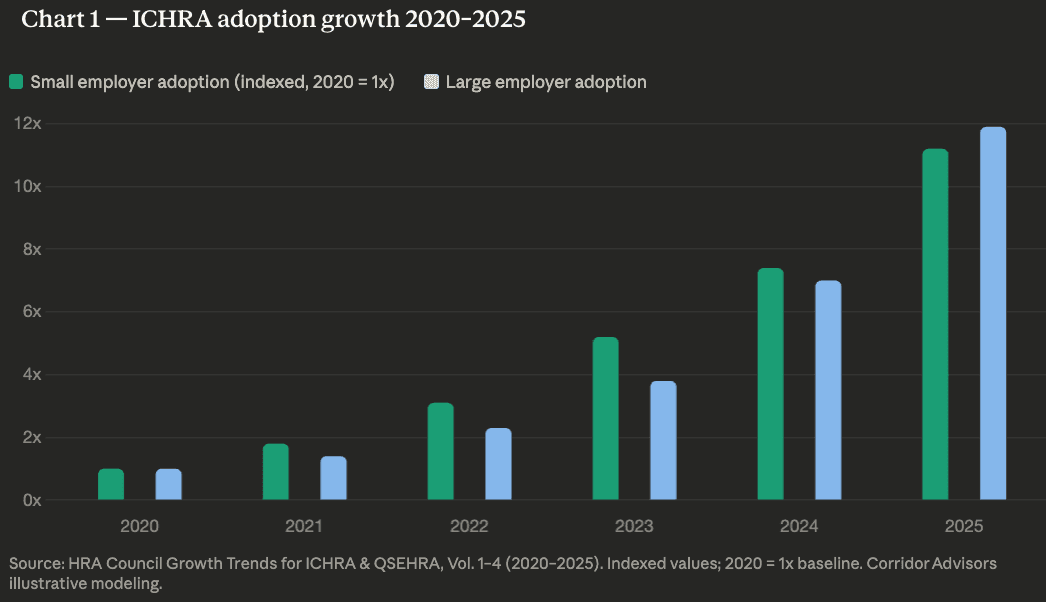
Key data points:
ICHRA adoption has grown over 1,000% since 2020 (HRA Council, 2025)
Small business ICHRA adoption up 52% from 2024 to 2025
Large employer adoption up 34% from 2024 to 2025
Google Trends interest in "ICHRA" grew nearly 4x between 2020 and 2024 Source: HRA Council Growth Trends for ICHRA & QSEHRA, Volume 4 (June 2025)
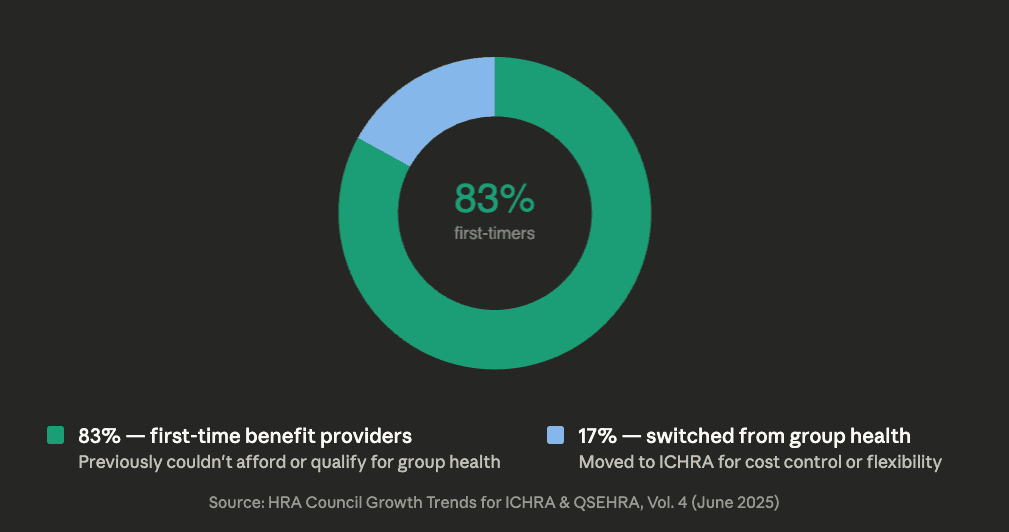
What that 83% figure means in plain language: ICHRA is bringing health benefits to small businesses that had been priced out of the traditional market entirely. It's not just a switcher story, it's an access story.
Employer retention is high too. Once employers try an HRA, 92% continue offering it the following year. That's not a product people are fleeing.
What Running ICHRA Actually Feels Like
The most common reaction I hear when I explain ICHRA: "That sounds complicated." It isn't.
Setup takes two to four hours using an ICHRA administration platform. After that, the platform handles monthly reimbursements, compliance, and employee support.
Here's what you actually do:
Step 1: Choose a platform. The platform handles the compliance paperwork, employee communications, and monthly reimbursement processing. We'll cover our two recommended platforms below.
Step 2: Set your reimbursement amount. You decide how much to contribute per employee per month. You can set different amounts for different groups — more for full-time than part-time, more for employees with family coverage than single. The rules give you real flexibility here.
Step 3: Employees shop and enroll. Each employee goes to their state exchange or the individual market and picks a plan. You never manage carrier negotiations, plan design decisions, or renewal paperwork.
Step 4: Monthly reimbursements run. Depending on the platform, employees either submit receipts for reimbursement or the platform handles enrollment and payment directly. Either way, you fund the account and the platform handles the rest.
What It Feels Like for Your Employees
From your employee's perspective, ICHRA starts with a notification: "Starting [date], your employer is offering a health reimbursement of $X per month toward individual health coverage."
They go to Covered California, their state's exchange, or directly to a carrier. They browse every plan available in their zip code. They pick the one that fits their situation — their preferred doctor, their preferred carrier, their preferred plan level.
The 28-year-old on your team picks a lean Silver plan that costs $260 a month. Your $400 reimbursement more than covers it. She pockets the rest or uses it toward dental. The 55-year-old on your team picks a Gold plan he needs for a specialist he's been seeing for years. It costs $520 a month. He adds $120 of his own money on top of your $400.
Both are covered. Neither had to compromise.
What about plan choice? In 2025, nearly 70% of employees using ICHRA selected Gold or Silver-tier plans — showing that employees make thoughtful, substantive coverage choices when given the option.
If they leave your company, they keep their plan. They just start paying the full premium themselves. No new enrollment, no coverage gap, no starting over.
One honest note: employees have to actively make a choice. Most find this straightforward, especially with modern platform tools. But if your team includes people who aren't comfortable navigating an insurance marketplace, make sure they have support. A good broker can walk employees through the selection process, and the platforms have gotten better at this. At Corridor, we work through the employee experience with every client's team — that's part of what we do.
The Two Platforms We Recommend
Corridor works closely with two ICHRA platforms and considers each the best in its respective market. Which one is right for you depends on what you're looking for.
Thatch — ICHRA That Feels Like a Group Plan
Cost: $45 per employee per month + $50/month compliance fee
Thatch is built around a simple idea: ICHRA should feel as seamless as traditional group benefits — but better. They've raised $84.5 million from investors including a16z, General Catalyst, Index Ventures, and ADP, and they've built the infrastructure to match.
When an employee joins your company under a Thatch ICHRA, they log into the Thatch platform and choose from health, dental, and vision plans spanning every major carrier in their area. Thatch handles enrollment directly with the carrier — employees never have to go to Covered California or manage a separate marketplace account. Thatch pays the carrier directly on the employee's behalf each month, so employees never have to front their own premium.
If employees spend less than their monthly allowance on their premium, the remaining balance goes onto a Thatch Visa debit card they can use for prescriptions, copays, therapy, and other healthcare costs. The platform also includes an AI-powered assistant called Ask Thatch, available 24/7 via text, that answers questions about coverage, eligible expenses, and account details.
Thatch also handles all ICHRA compliance — plan documents, employee notices, and the reporting and documentation required to stay on the right side of the IRS. For employers, it's genuinely close to a set-it-and-forget-it experience.
Thatch is now integrated directly into RUN Powered by ADP, which means if you're already using ADP for payroll, the setup is even more streamlined.
Best for: Employers who want the benefits experience to feel premium and polished — close to what employees expect from a traditional group plan, without the one-size-fits-all constraints.
Salusion — Lean, Fast, Fully Automated
Cost: $14 per employee per month. No setup fees, no platform fees, no minimums.
Salusion is what you'd expect when you describe ICHRA in its purest form: a clean, highly automated administration layer that handles the compliance, the expense verification, and the ACH reimbursements with almost no ongoing involvement from you.
Employees can shop for and purchase individual coverage directly through the Salusion platform. Once enrolled, they submit premium receipts (or authorize recurring reimbursement via a simple text confirmation), and Salusion verifies the expense and transfers the reimbursement directly to their bank account via ACH — no payroll cycle required, no manual work from you. Salusion claims their support team answers most emails in under an hour, and they offer same-day Zoom calls for employers and employees who want to talk through their situation.
Salusion's philosophy is transparency. Their pricing is public, their process is documented, and they're explicit that an ICHRA is a reimbursement arrangement — the employer sets the allowance, the employee picks the plan, and the platform handles the accounting. For small businesses that want to offer a genuine monthly health benefit without the overhead of a full-service platform, Salusion is the most cost-effective serious option on the market.
Best for: Employers who want to offer a clean, simple reimbursement benefit with minimal overhead — and who don't need the white-glove platform experience.P, Gusto, QuickBooks, others
At Corridor, we're very well-versed in the ICHRA landscape.
We're happy to advise on platform selection and serve as your independent advisor throughout setup and beyond — at no additional cost to you.
We're also happy to lead your discovery into other platforms if neither of these feel right to you.
When ICHRA Is the Right Answer
Here's when ICHRA almost always wins.
Under 10 employees. Small group health insurance has minimum participation requirements — carriers often require 70% of eligible employees to enroll before they'll issue a policy. With a small team, that can be hard to hit. Community-rated pricing for small groups also rarely produces favorable economics at this size. ICHRA lets you set a precise budget and let each employee find the most efficient plan for their own age and zip code.
Distributed teams. If your employees are in multiple states, group health gets complicated fast. You'd need a national carrier with real networks everywhere, which is expensive and limiting. With ICHRA, each employee shops their own local market. One reimbursement budget covers everyone.
Diverse workforce needs. When some employees want Kaiser HMO and others need a specific specialist covered under a PPO, there's no single group plan that satisfies everyone. You end up forcing a compromise. ICHRA solves this entirely.
States where individual market pricing is favorable. This varies by state and by the age mix of your team. California, Georgia, and Ohio — the states where Corridor works — all have active individual markets. The Ideon ICHRA Insights tool at ideonapi.com/ideon-ichra-insights-by-state maps where ICHRA tends to be most competitive against small group health, state by state.
When you want fixed, predictable costs. Group health premiums change at renewal. Your carrier can raise rates 10–20% and you have limited options. According to a 2025 survey of benefits consultants, employers expect healthcare costs to rise 9.2–9.5% in 2026. Some smaller companies are seeing renewals jump as much as 30% in a single year. With ICHRA, your monthly cost is exactly what you set it to be.
When Group Health Is Still the Right Answer
ICHRA is not always the better option. Here's when group health wins.
Larger groups at a single location. At 50 or more employees, group health builds real carrier leverage. A two-to-three-tier plan design can produce meaningful savings. The math changes at scale.
When specific network access is non-negotiable. If a key employee needs to stay on a specific hospital system or with a particular specialist that only participates in certain carrier networks, a group health plan can guarantee that access. With ICHRA, employees choose freely, and they might not all end up on the same carrier.
When you want to make one decision. Some owners don't want to delegate the coverage choice to each individual employee. They want to evaluate options once, pick a plan, and be done. Group health is simpler in that sense.
Neither structure is universally right. The honest answer for most small businesses under 10 employees is: run both scenarios before you decide. It costs nothing and takes a few days.
The Community Rating Factor
Here's something that surprises most small business owners.
When you buy small group health insurance, your premium is community-rated. Your carrier doesn't look at your team's individual health history. They price based on your employees' ages, your location, and the plan you select — across the entire small group pool in your rating area.
This means a 4-person firm and a 40-person firm buying the same plan in the same city pay roughly the same per-person premium. Being small doesn't give you better rates.
It also means that if several of your employees are in their 50s or 60s, the community-rated premium reflects those ages across the whole group.
With ICHRA, each employee shops the individual market independently. A 30-year-old is not in the same pricing pool as a 55-year-old. They each face individual market pricing for their own age bracket. For employers whose group rate has been pushed up by a mixed-age team, ICHRA can produce a meaningfully lower per-person cost. That's a genuine structural difference.
The Most Common Question: Will Employees Hate It?
Usually, no. Most employees don't love being stuck on whatever plan their employer chose. They're on that plan because they had no other option, not because it's exactly right for them. ICHRA gives them actual choice, and most people respond well to that once they understand what it means. Actually, an ICHRA can be hard to switch away from because employees will get used to the choice.
The framing matters. Don't present this as "we're cutting health benefits." Present it as: "Instead of picking one plan for everyone, we're giving each of you a monthly budget to pick the plan that fits your own situation. You keep your plan even if you leave."
That's a meaningful benefit. In 2025, nearly 70% of employees on ICHRA selected Gold or Silver plans — substantial coverage, chosen by people with real options. And the dependent enrollment rate has grown year over year, meaning employees are bringing their families onto the coverage they're choosing, not just settling for whatever their employer handed them.
Give employees the full 90 days to shop. Explain clearly what the reimbursement amount is. Make sure they know where to get help. At Corridor, we work through this transition with every client's team directly.
How to Find Out if ICHRA Is Right for You
The right next step is a real comparison.
All we need is a list of your employees' dates of birth and zip codes. From there, we can show you what group health would cost versus what ICHRA would cost at a given reimbursement level. That comparison takes 48–72 hours to build, and it's free.
We run this analysis for every client under 50 employees. Not because ICHRA always wins. Sometimes it doesn't. But because the comparison is always worth doing before you commit.
About the Author
Nikhil Aggarwal CEO & Co-Founder, Corridor Advisors Licensed Health Insurance Broker | NPN: 22108801 Last updated: April 7, 2026
Corridor Advisors is a health insurance brokerage for small businesses with 1 to 50 employees.
Related Articles


Small businesses are the backbone of America.
20 million Americans get their health benefits from a small employer. Corridor is the brokerage built to serve them.